Overview
That is one of the more revealing behaviours in major projects.
Because contingency is often treated as:
a number,
a target,
a percentage uplift,
or a governance requirement,
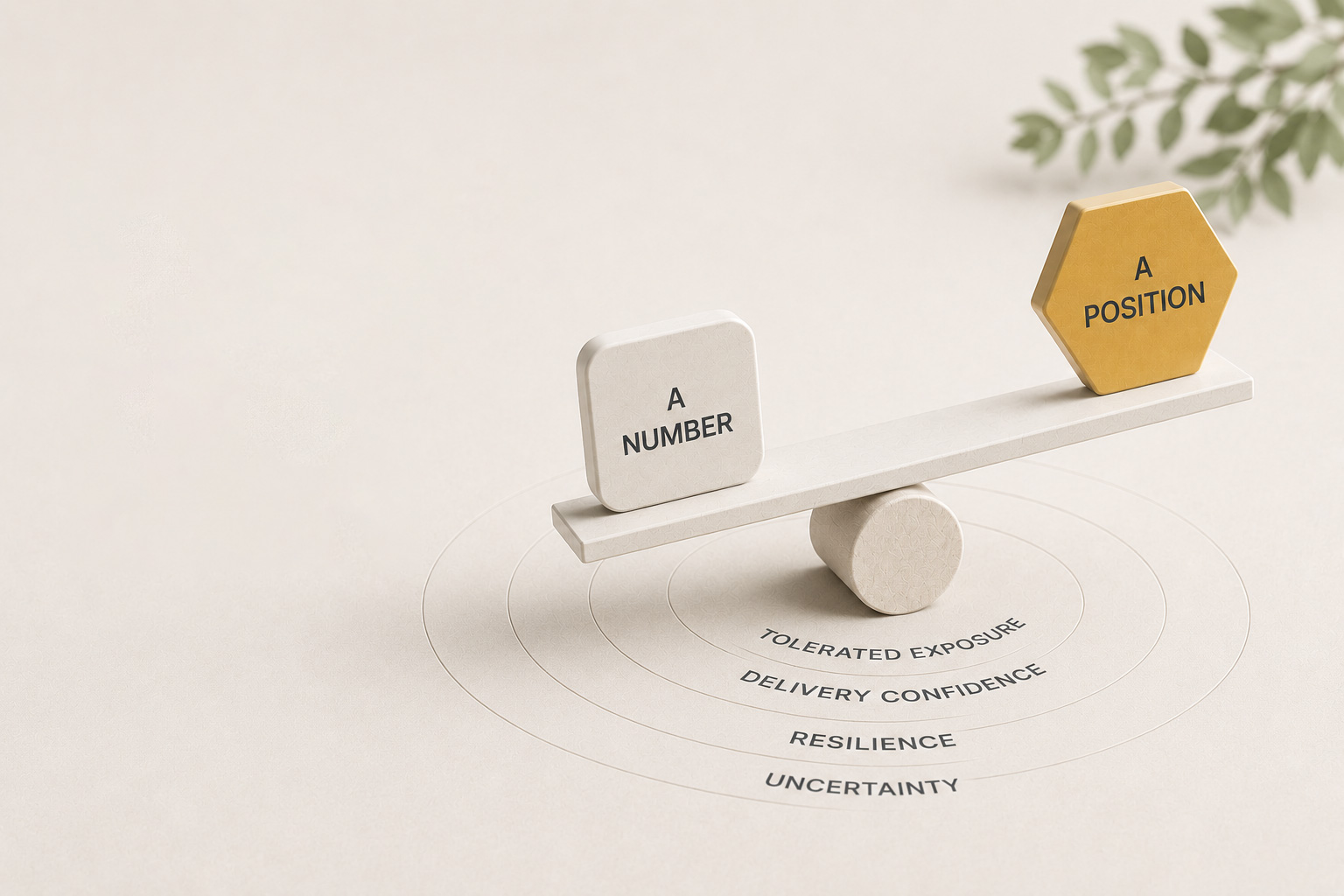
rather than what it actually represents:an organisational position on uncertainty, resilience, delivery confidence, and tolerated exposure.
Earlier articles in this series explored how uncertainty becomes distorted through:
behavioural simplifications,
scenario compression,
false precision,
governance translation,
and the disconnect between modelling outputs and real decisions.
But eventually, many of those distortions surface in one place:contingency.
Contingency becomes the organisational expression of:
what the project believes,
what governance is willing to tolerate,
how uncertainty is interpreted,
and how much instability the organisation believes it can absorb.
That is why contingency debates often become surprisingly emotional, political, and strategically sensitive.
Because underneath the percentile discussions sits a far more important question:
What kind of uncertainty is the organisation actually prepared to live with?
Contingency Is Not Certainty
One of the most persistent misunderstandings in project environments is the assumption that contingency somehow "solves" uncertainty.
It does not.
A contingency value is not a promise.
It is an expression of tolerated uncertainty.
This distinction matters enormously.
Particularly in major infrastructure environments where:
scope maturity evolves gradually,
interfaces remain unstable,
productivity varies over time,
market conditions shift,
and delivery pressure compounds dynamically.
A P90 contingency does not mean:
the project is now "safe,"
the budget is protected against all outcomes,
or uncertainty has been eliminated.
It simply reflects a probabilistic position under a particular set of assumptions.
And as explored in earlier articles:those assumptions are often shaped by:
judgement,
optimism,
governance pressure,
behavioural simplification,
and incomplete visibility.
A percentile does not remove uncertainty.
It describes uncertainty under assumed conditions.
That is a very different thing.
Contingency Reflects Governance Philosophy as Much as Modelling
Projects often behave as though contingency is purely a technical output from QCRA.
In reality, contingency reflects much more than modelling.
It reflects:
organisational risk appetite,
funding philosophy,
governance culture,
delivery flexibility,
confidence expectations,
and tolerance for instability.
This is why two organisations can review the same exposure profile and arrive at very different contingency positions.
Not necessarily because one model is wrong.
But because:
their tolerance for uncertainty differs,
their recovery capacity differs,
their governance behaviour differs,
and their strategic priorities differ.
The "correct" contingency does not exist independently from those conditions.
A contingency value only becomes meaningful in the context of:
what the organisation is trying to protect,
how resilient the delivery environment actually is,
and how much exposure leadership is genuinely prepared to absorb.
This is one reason simplistic P50 versus P90 debates often become misleading.
Projects frequently argue about:
the percentile,
the optics,
or the funding position,
before aligning on the underlying philosophy of uncertainty tolerance itself.
Contingency Is Often Consumed Before Uncertainty Reduces
One of the most common behaviours in major projects is that contingency begins eroding long before uncertainty meaningfully collapses.
This happens repeatedly across:
infrastructure programmes,
rail environments,
complex interface projects,
and early-stage delivery portfolios.
The project may still carry:
immature scope,
unresolved interfaces,
evolving access assumptions,
uncertain productivity,
procurement instability,
or incomplete design maturity.
Yet pressure gradually emerges to:
narrow contingency positions,
improve affordability optics,
align with funding expectations,
or commit to tighter delivery positions than project maturity realistically supports.
Sometimes this happens because:
governance wants confidence,
funding approvals require tighter positions,
or commercial pressure rewards optimistic narratives.
Sometimes it happens simply because contingency starts being viewed as "available money."
That distinction is critical.
Contingency is not the same as forecast movement or live risk exposure.
Nor is it simply spare funding waiting to be consumed.
Its purpose is to preserve resilience against uncertainty that has not yet materialised.
But many projects begin consuming contingency long before uncertainty meaningfully collapses.
The consequence is often predictable:projects appear financially tighter and more stable on paper while remaining behaviourally fragile underneath.
Contingency and Change Are Not the Same Thing
Another area where projects frequently become confused is the distinction between:
uncertainty within scope,and:
actual scope change.
In theory, contingency is intended to absorb uncertainty associated with delivering the approved scope.
But in practice, projects often expect contingency to absorb:
evolving scope,
underestimation,
design development,
commercial compromise,
optimism bias,
and emerging delivery pressure simultaneously.
Over time, the line between:
contingency,
change,
recovery,
and funding shortfall
can become increasingly blurred.
This creates a dangerous behavioural drift.
Because once contingency becomes expected to absorb every emerging pressure within the project environment, its strategic purpose starts disappearing.
Contingency cannot realistically protect against:
every change in project direction,
every governance compromise,
every commercial concession,
and every underestimated assumption simultaneously.
Yet many organisations behave as though it should.
The Existence of Contingency Changes Behaviour
One of the least discussed realities in project delivery is that contingency itself influences behaviour.
The existence of contingency can change behaviour as much as the absence of it.
Large contingency positions can create:
confidence,
flexibility,
and resilience.
But they can also create:
psychological comfort,
reduced commercial discipline,
pressure to utilise available funding,
or assumptions that recovery capability exists regardless of delivery performance.
At the same time, very constrained contingency positions can create different behavioural distortions:
hidden optimism,
suppressed escalation,
compressed assumptions,
or governance narratives designed to preserve affordability.
This is one reason contingency debates become so politically sensitive.
Because contingency is not only a financial discussion.
It is also a behavioural signal about:
confidence,
accountability,
delivery pressure,
and organisational tolerance for uncertainty.
P90 Is Not Protection Against Every Future
One of the more dangerous governance misunderstandings is the idea that selecting a higher percentile somehow neutralises uncertainty.
It does not.
A percentile is conditional.
If:
tail exposure is understated,
behavioural escalation is compressed,
dependencies are oversimplified,
or uncertainty has been politically narrowed,
then the percentile inherits those weaknesses.
This is especially important because many organisations unconsciously reinterpret:
"P90"as:
"safe enough."
But probabilistic modelling does not eliminate the possibility of outcomes beyond the percentile.
Nor does it guarantee that the assumptions underneath the model realistically reflect how the project will behave under stress.
As discussed in earlier articles:
precision is not accuracy,
convergence is not credibility,
and stable outputs do not necessarily mean stable understanding.
The same applies to contingency.
A percentile is not a shield against uncertainty.
It is a representation of uncertainty under assumed behavioural conditions.
Good QRA Should Shape Contingency Philosophy, Not Just Calculate It
One of the quieter limitations in many project environments is that QCRA often becomes heavily focused on calculating contingency while spending far less time exploring:
what the contingency is actually protecting,
how uncertainty behaves operationally,
or how resilient the project remains under stress.
That is where modelling should become strategically useful.
Good QRA should not merely produce:
P50,
P90,
or contingency ranges.
It should help organisations explore:
how exposure behaves under alternative delivery conditions,
where resilience begins deteriorating,
how behavioural escalation changes outcomes,
and which uncertainties materially threaten delivery confidence.
This is where earlier themes in the series become directly connected:
behavioural realism matters because it shapes exposure,
governance distortion matters because it shapes interpretation,
and decision-focused modelling matters because contingency is ultimately a strategic decision tool.
Because the real question is rarely:"What is the contingency?"
The more important question is:"What level of uncertainty is the organisation genuinely prepared to absorb without losing delivery stability?"
Resilience Matters More Than Optics
One of the more uncomfortable realities in major projects is that contingency is often optimised for:
approvals,
affordability,
governance comfort,
or business case optics,
rather than delivery resilience.
Projects naturally want:
cleaner funding positions,
tighter ranges,
stable forecasts,
and defendable narratives.
But uncertainty does not collapse simply because governance prefers stability.
The purpose of contingency is not to make a business case look acceptable.
It is to preserve resilience when uncertainty materialises.
That distinction matters enormously.
Because projects rarely fail due to a single isolated event.
More often, they become progressively less resilient:
assumptions weaken,
flexibility reduces,
recovery capacity deteriorates,
and cumulative pressure compounds gradually over time.
Once resilience erodes sufficiently, even relatively modest disruption can become strategically significant.
What Mature Contingency Thinking Looks Like
Good contingency practice is not about finding the "perfect" number.
It is about understanding:
what uncertainty exists,
how that uncertainty behaves,
what assumptions are embedded in the model,
and how much exposure the organisation is realistically prepared to absorb.
In practice, mature contingency thinking often involves:
distinguishing uncertainty from change,
aligning contingency with risk appetite,
stress-testing contingency under adverse conditions,
revisiting assumptions continuously,
focusing on material drivers rather than cosmetic precision,
and preserving transparency around uncertainty maturity.
It also requires recognising that:
contingency is not spare funding,
and contingency is not proof of safety.
Contingency only becomes meaningful when organisations understand:
what it is intended to protect,
what assumptions it depends upon,
and how uncertainty actually behaves operationally.
Closing Thought
Contingency is often treated as a number produced by QCRA.
But contingency is rarely just numerical.
It reflects:
governance philosophy,
uncertainty tolerance,
behavioural assumptions,
delivery resilience,
organisational pressure,
and strategic confidence.
That is why contingency discussions become far more complicated than percentile selection alone.
Because underneath the modelling sits a more difficult reality:
Projects are not deciding only how much contingency to carry.
They are deciding:
how much uncertainty they believe exists,
how much instability they are willing to tolerate,
and how resilient they expect the project to remain when assumptions begin failing.
And those are not purely modelling decisions.
They are leadership decisions.