Beyond the Model: Why QCRA Fails Decisions and How to Fix It
Most QCRA models are built correctly.Many are even technically sound.They follow accepted methods.They use recognised tools.They produce outputs that appear structured, consistent, and defensible.
Yet, despite the effort that goes into them, they often fail to influence the decisions they are meant to support.
That is the real problem.
Not whether the distribution was triangular or PERT.Not whether the model used 5,000 or 50,000 iterations.Not whether the logic was elegant or complex.Those things matter, but they are not where QCRA succeeds or fails.The failure point sits elsewhere.
It sits in the gap between:
what is modelled,
how it is modelled, and
how the result is actually used.
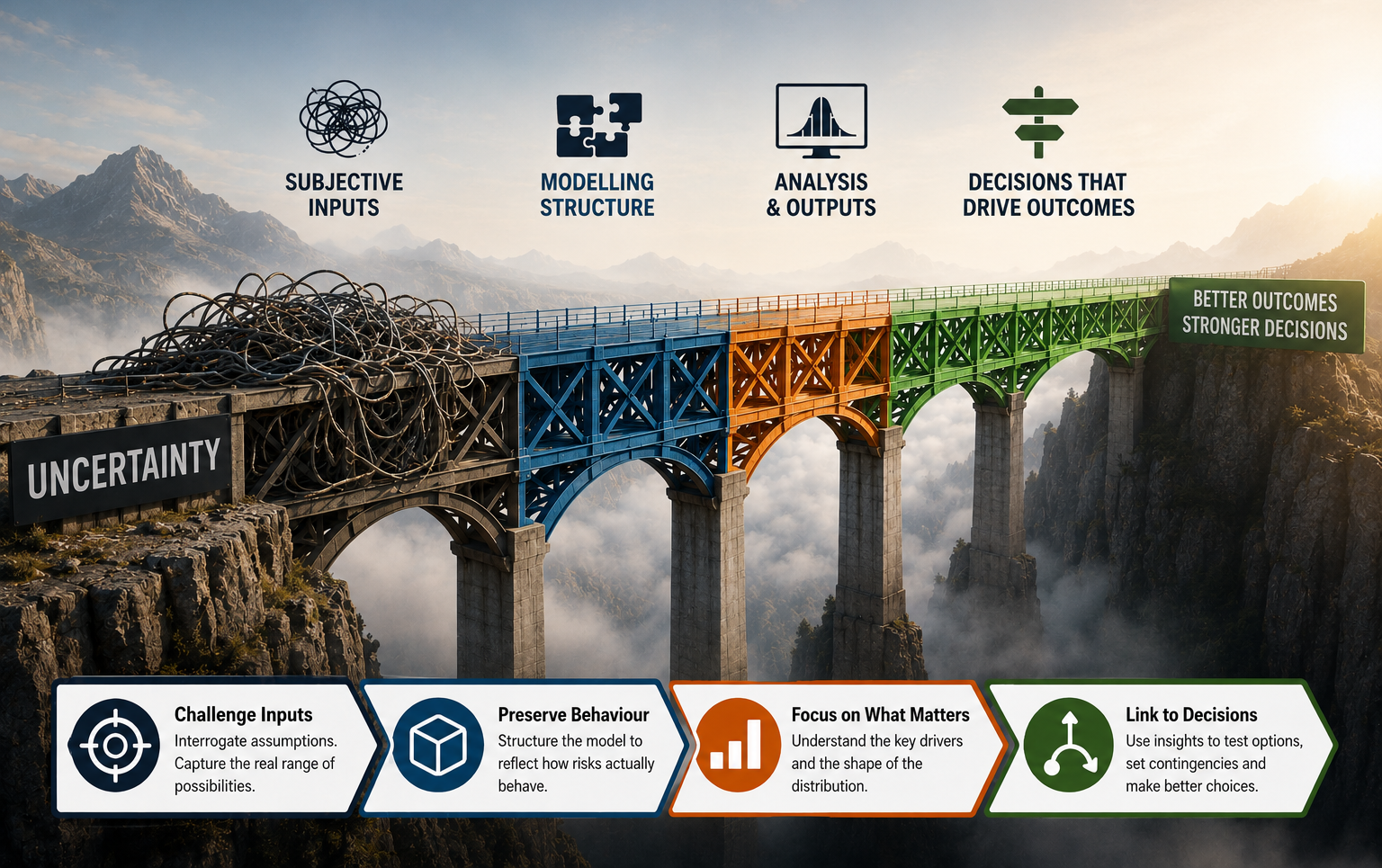
In practice, most QRAs struggle in three interconnected areas:
Inputs that are subjective, inconsistent, and often biased
Modelling structures that reshape behaviour to fit templates
Outputs that are reported as numbers, but not used to test decisions
Individually, each of these is manageable.Combined, they produce something that looks credible, but is not decision-relevant.
This article is not about making models more complex.It is about making them useful.It builds on earlier articles I've written in this series on distribution choice, behavioural modelling, and scenario structuring, but shifts the focus to a more fundamental question:
What actually makes a QRA useful for decisions?
Inputs: The Real Constraint
It is difficult to argue with a simple truth:
A model cannot be better than its inputs.In most projects, those inputs are not derived from empirical datasets.They are derived from judgement.
That judgement is shaped by:
experience, often limited to a small number of projects
organisational, commercial, and reputational pressures
delivery culture, including optimism bias and schedule expectations
and the tendency to recall past outcomes selectively and inconsistently
As a result:
worst cases are often understated
best cases are often optimistic
ranges are anchored to what feels reasonable, not what is plausible
This is not a failure of individuals.It is a feature of how projects operate.
The issue is not that inputs are subjective.The issue is that we often treat them as if they are objective.
In cost estimating, assumptions are interrogated, benchmarked, and challenged.In risk modelling, inputs are frequently accepted with far less scrutiny.Once defined, they are fed into a model that simulates thousands of iterations with apparent rigour.
This creates a structural imbalance:
We simulate uncertainty with precision, but we define it with bias.
At that point, the model is already constrained.No level of mathematical sophistication can fully correct for weak or biased inputs.
But that does not mean modelling does not matter.Because what happens next is just as important.
Where Modelling Makes Things Better, and Where It Makes Them Worse
Even when inputs are imperfect, the way we structure them in the model still matters.In many cases, the model does not simply reflect uncertainty.It reshapes it.
This often happens quietly, through choices that are seen as practical or standard:
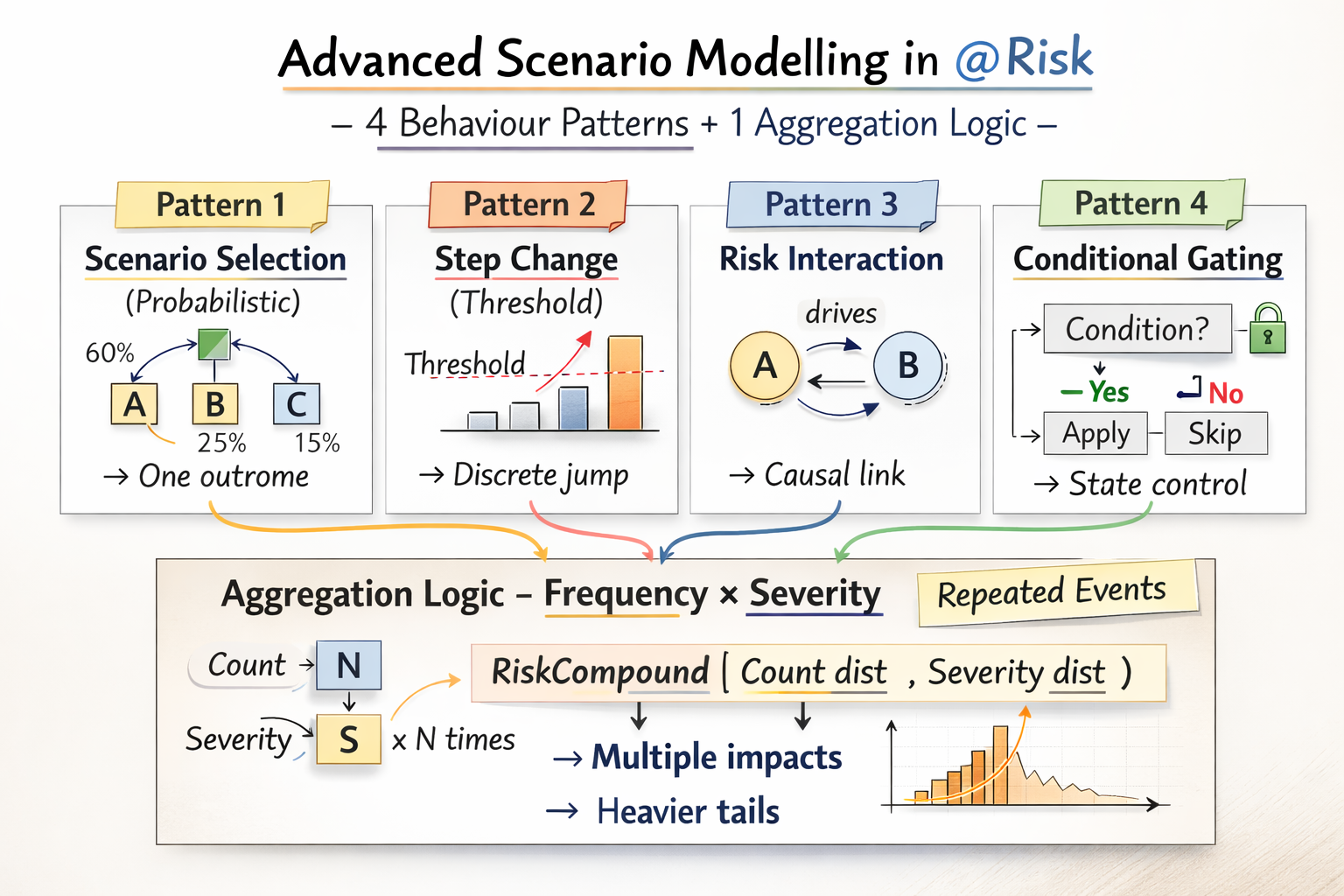
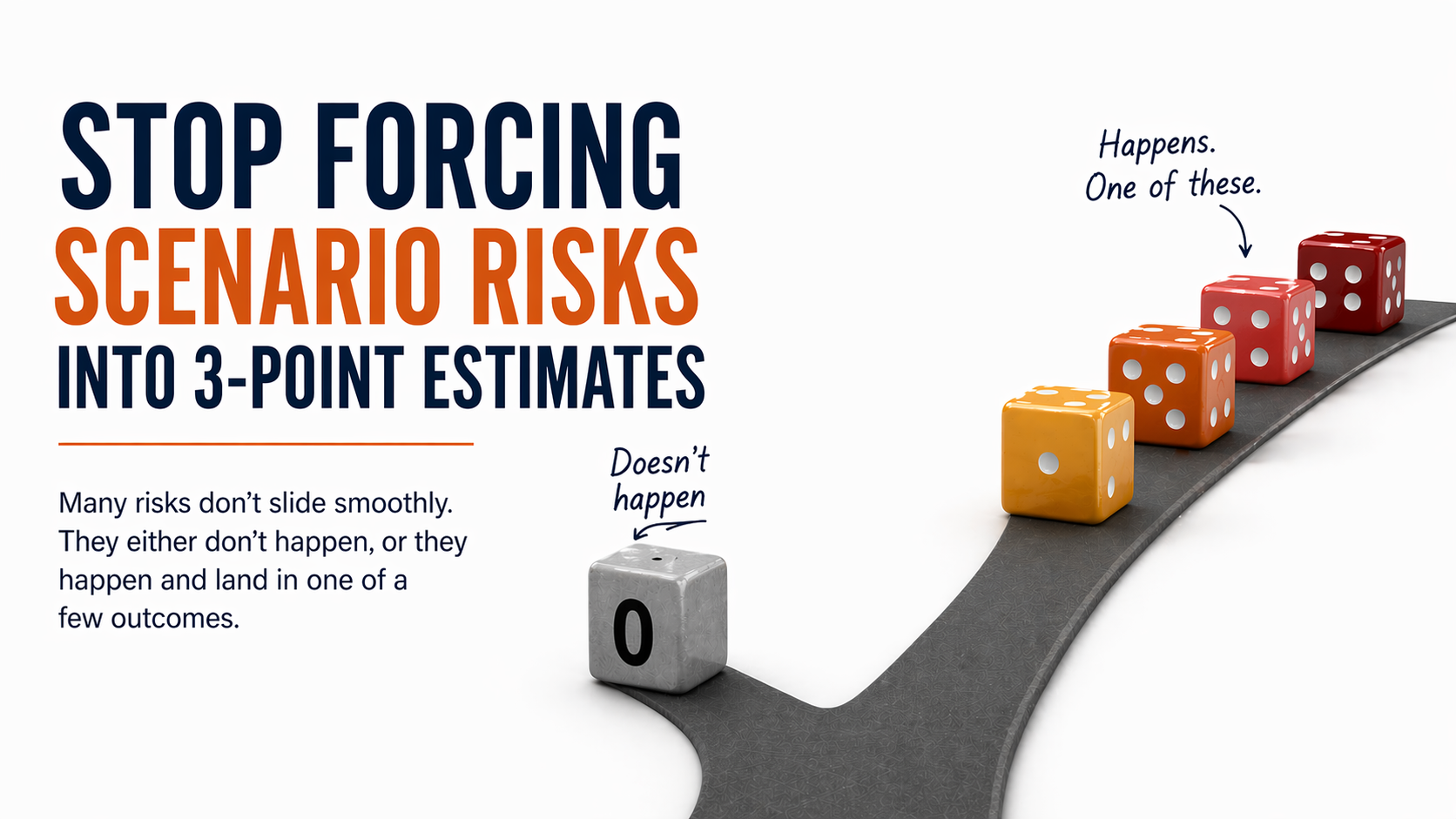
Discrete scenario behaviour is compressed into smooth ranges
Probability and impact logic are structured in ways that dilute tail behaviour
Dependencies and conditional behaviour are simplified into independent risks
Model outputs are interpreted without challenging the assumptions driving them
These are not just technical simplifications.They reshape how the model behaves.They change how the model "experiences" the risk.
The consequence is most visible in the tail.
Rare but high-impact outcomes become diluted
Distinct risk behaviours are blended into artificial averages
The frequency and magnitude of extreme scenarios are understated
This matters because:
The tail is where decisions are made.
Funding, contingency, and strategy are rarely anchored to the mean.They are anchored to higher percentiles, where these distortions accumulate.
This is the key distinction:
Weak inputs are a constraint.Poor structure is a distortion.
A model with imperfect inputs can still be useful if it preserves the behaviour described by SMEs.
A model that reshapes that behaviour, even with clean mathematics, can lead to systematically misleading conclusions.
This is where modelling still has a critical role.Not to "fix" inputs, but to ensure that whatever has been captured is not further distorted.
Systemic Uncertainty and the Limits of the Risk Register
Another layer of complexity sits outside individual risks.
Projects are influenced by broader, systemic factors:
labour, material, and market volatility
contractor, supplier, and interface performance
productivity variability across delivery activities
coordination and delivery complexity
evolving scope, constraints, and external pressures
These are not always captured explicitly in risk registers.
They are often represented through:
estimate uncertainty ranges
parametric adjustments
broad schedule and cost contingency bands
or high-level allowances
In many cases, these systemic factors dominate outcomes.
At the same time, risk registers focus on identifiable events:
specific design issues
procurement risks
approval delays
interface challenges
Both perspectives are valid.But each, on its own, is incomplete.
A purely systemic view can obscure key drivers and specific exposures, making it difficult to prioritise mitigations or challenge underlying assumptions.
A purely risk-based view can underestimate underlying variability
The challenge is not choosing one over the other.It is integrating both in a way that reflects how projects actually behave.And critically, in a way that supports decisions.
The Real Gap: From Numbers to Decisions
Even when inputs are reasonable and modelling is sound, another gap remains.Most QCRA outputs stop at a number: P50, P80, P90.These are produced, reviewed, and sometimes debated in detail.But too often, they are treated as the end of the process.This is where the real disconnect appears.
The question that matters is not:
"What is the P80?"
It is:
"What decision does this change?"
If the answer is unclear, the model has limited practical value.
In many cases, QRA is used to:
justify a contingency value
satisfy governance requirements
support predetermined funding positions
or provide a sense of analytical rigour
Less often is it used to actively test decisions such as:
whether a different delivery strategy reduces exposure
whether different packaging strategies alter the risk profile
whether contingency is sufficient under alternative scenarios
whether schedule allowances are aligned with credible delivery outcomes
whether the current plan remains viable under stress
When uncertainty and scenario-style risks are modelled appropriately, they do more than shift a percentile.They help decision-makers test strategies, understand where plans become vulnerable, and evaluate which actions materially improve resilience and delivery confidence.
That is where QRA becomes decision-relevant.Not as a reporting tool, but as a mechanism for exploring choices under uncertainty.
What Good Looks Like
A useful QRA is not defined by how detailed or complex it is.It is defined by how clearly it supports decisions.
In practice, this means:
Inputs are recognised as judgement-based and are actively challenged
Modelling structure preserves the behaviour described by SMEs
Different types of uncertainty, systemic and event-based, are treated deliberately
Outputs are interpreted in the context of decisions, not just reported
It also means being selective.Not every risk requires detailed modelling.
In fact, over-modelling low-impact risks can:
add complexity
reduce transparency
and distract from what actually matters
The focus should be on the drivers.
The small number of risks and uncertainties that:
shape the tail
influence key outcomes
and have the potential to change decisions
This is where effort adds value.
Practical Shifts That Make a Difference
Improving QRA does not require a complete overhaul.
It requires a shift in emphasis.
Spend more time interrogating inputs, and less time refining distribution types
Focus modelling effort on high-impact drivers, rather than every line item
Preserve scenario behaviour where it exists, rather than averaging it away
Use the model to test decisions, not just produce percentiles
Keep the structure transparent enough to be explained and challenged
At the same time, recognise that:
simplicity is useful, but not if it distorts behaviour
complexity is sometimes necessary, but only where it adds clarity
The objective is not elegance.It is usefulness.
Closing Thought
QRA is often treated as a modelling exercise.It is not.It is a decision support tool.The goal is not to produce a number that looks credible.It is to provide clarity under uncertainty.
That requires:
inputs that are understood and challenged
modelling that preserves behaviour
and outputs that are directly linked to decisions
Without that, even the most sophisticated model has limited value.
Because in the end:
If the model does not change a decision, it is just a number.