Understanding Schedule Uncertainty
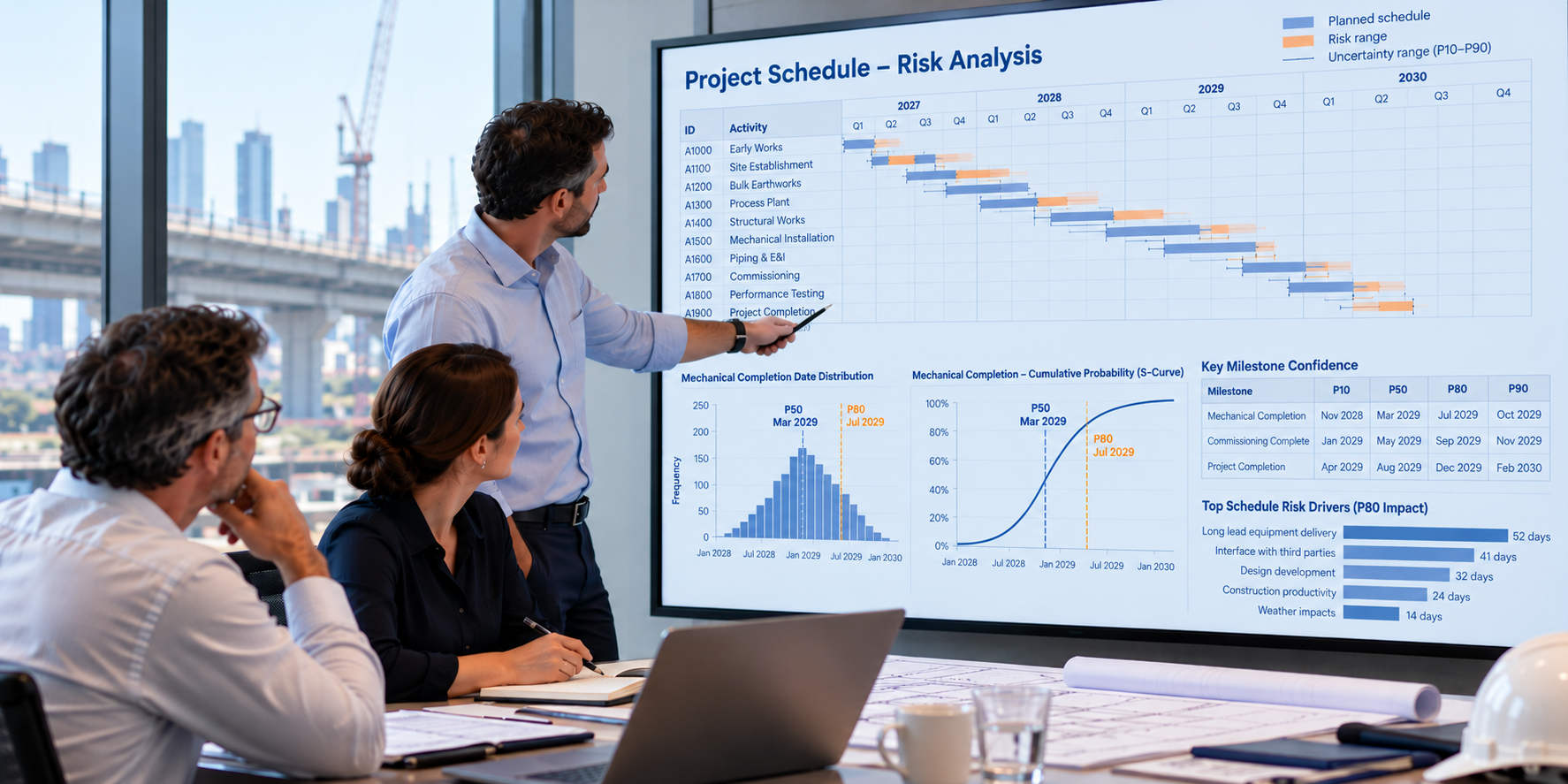
Quantitative Schedule Risk Analysis (QSRA) provides an evidence-based assessment of uncertainty in a project schedule. Using probabilistic modelling and Monte Carlo simulation, it helps organisations understand the likelihood of achieving key milestones, assess time contingency requirements and make informed delivery decisions.
Trajectory undertakes QSRA for complex infrastructure and capital projects, including standalone engagements to support business cases, gateway reviews, project approvals and milestone assessments.
Why Schedule Risk Analysis Matters
A project programme sets out planned activities, dependencies and milestone dates. However, a deterministic completion date does not, by itself, indicate the likelihood of achieving that date.
Quantitative Risk Analysis (QRA) provides a structured way to assess schedule uncertainty, considering activity duration uncertainty, identified risks and the relationships between activities.
The result is a clearer understanding of potential completion dates, milestone confidence and the factors that contribute most significantly to delay.
How We Help
Trajectory's QSRA services can include:
- Schedule risk modelling: Combining activity duration uncertainty and identified risks within a probabilistic schedule model.
- Milestone confidence assessment: Evaluating the probability of achieving target dates and key milestones.
- Time contingency assessment: Establishing an evidence-based basis for evaluating schedule contingency requirements.
- Critical path and sensitivity analysis: Identifying the activities, dependencies and risks that contribute most significantly to schedule exposure.
- Independent review: Assessing an existing QSRA model, its assumptions, inputs and outputs.
The scope is tailored to the maturity of the programme, the available information and the decisions the analysis needs to support.
When We Help
Organisations engage Trajectory to undertake QSRA when they need to:
- Support a business case, investment decision or gateway review.
- Assess confidence in key milestones or completion dates.
- Establish or review time contingency requirements.
- Understand the principal drivers of potential delay.
- Evaluate schedule exposure before making delivery commitments.
- Review an existing quantitative risk assessment.
Cost and Schedule Risk Integration
Schedule delays can affect project costs through extended delivery periods, additional resources, prolongation and other time-related impacts. Cost and schedule risks may also share common causes.
Where both dimensions need to be assessed, Trajectory can undertake Integrated Cost and Schedule Risk Analysis (iCSRA), bringing cost and schedule modelling together to provide a more complete view of project exposure.
If your primary requirement is cost confidence and contingency, explore our Quantitative Cost Risk Analysis (QCRA) service.
Our Approach
We begin by understanding the programme, the available schedule information and the decisions to be supported. We then establish the appropriate analytical approach, review or develop the probabilistic model, evaluate the results and communicate the findings in a clear, practical format.
Our focus is on making schedule uncertainty understandable and analysis useful for decision-making.
Trajectory maintains licences for @RISK, Primavera P6, Primavera Risk Analysis (PRA), Safran Risk and Deltek Fuse, allowing us to undertake specialist risk analysis using appropriate tools without necessarily requiring clients to purchase additional software licences for the engagement.
Start a Conversation
Need a QSRA or broader QRA for an upcoming project decision?
Contact Trajectory to discuss your requirements and how quantitative schedule risk analysis can help strengthen confidence in your programme.